 USA
USA UK
UK Europe
 Australia
 Canada
 UAE
UAEHow to Set Up OpenAI Ads and Run Ads on ChatGPT: A Complete Step-by-Step Guide
Meta Title: How to Set Up OpenAI Ads & Run ChatGPT Ads: Complete Guide
Meta Description: Learn how to set up an OpenAI Ads account, create ChatGPT ad campaigns, choose campaign objectives, target audiences, create ads, track conversions and optimize campaigns.
Suggested URL: /openai-chatgpt-ads-guide/
What Are OpenAI Ads?
The way people discover information online is changing.
Traditionally, businesses have relied on search engines such as Google to reach customers. A user searches for a keyword, reviews search results and clicks an advertisement or website.
AI-powered platforms introduce a different type of discovery.
Instead of searching for:
"best SEO agency India"
a potential customer might ask:
"How can I make my company appear in ChatGPT recommendations?"
or:
"What should a B2B company do to improve its visibility in AI search?"
This creates a new advertising opportunity around conversation, context and user intent.
OpenAI Ads Manager enables advertisers to create campaigns designed to reach relevant ChatGPT users. Current campaign objectives include Views, Clicks and Conversions, while advertisers can also use geographic, platform and audience targeting options depending on account eligibility and campaign type.
For businesses and agencies, the opportunity is not simply to reproduce Google Ads inside ChatGPT. The bigger opportunity is to understand how users interact with AI and build advertising campaigns around those contexts.
What Is OpenAI Ads Manager?
OpenAI Ads Manager is the advertising platform used to create and manage advertising campaigns associated with ChatGPT.
It provides advertisers with tools to:
- Create advertising campaigns
- Define campaign objectives
- Set budgets
- Select geographic markets
- Select platforms
- Define audience/context signals
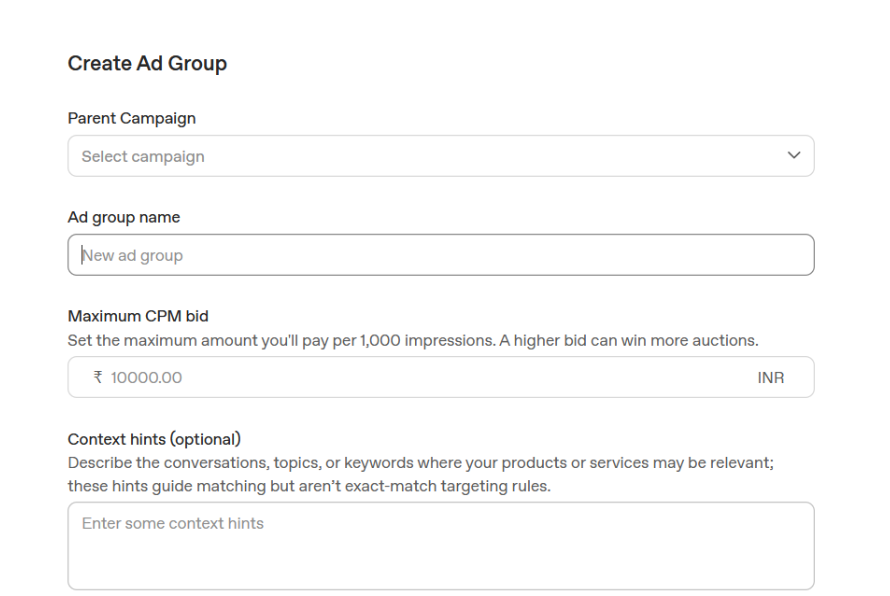
- Create ad groups
- Create advertisements
- Monitor campaign performance
- Optimize campaigns based on results
The platform uses a campaign structure similar to other major advertising platforms, but the way advertisers should think about audience relevance is different.
The basic structure is:
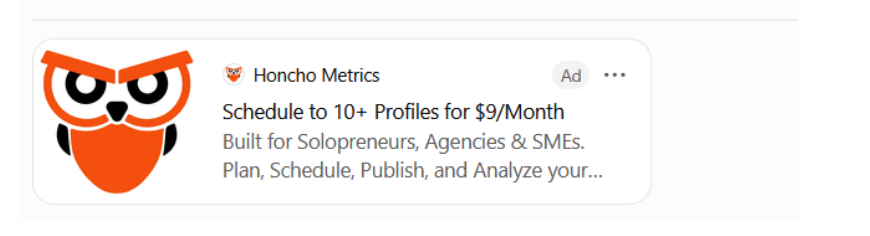
Campaign → Ad Group → Ad
A campaign represents the overall marketing objective.
An ad group organizes advertisements around a particular audience, problem, product or context.
The ad is the actual message shown to the user.
Why ChatGPT Advertising Is Different From Traditional Search Advertising
One of the biggest mistakes a marketer can make is treating ChatGPT advertising exactly like Google Search advertising.
Traditional search advertising often starts with:
Keyword → Search Query → Advertisement
AI advertising can be approached more contextually:
Conversation → User Need → Context → Relevant Advertisement
Consider two examples.
Traditional search
A person searches:
"AI SEO agency"
The advertiser targets the keyword and displays an advertisement.
Conversational discovery
A person asks:
"How can I increase my company's visibility in ChatGPT?"
The important information isn't simply the words in the question.
The context tells us that the person may be:
- researching AI visibility,
- looking for an SEO solution,
- trying to understand GEO,
- evaluating agencies,
- looking for a service provider.
This means advertisers should think beyond keywords and understand the problem behind the conversation.
Who Should Consider OpenAI Ads?
OpenAI Ads can potentially be relevant to businesses that want to reach users while they are researching products, services, solutions or information.
Potential categories include:
B2B companies
Examples:
- SaaS companies
- Technology companies
- Consulting companies
- IT services
- Marketing agencies
- Business software
Ecommerce
Examples:
- Fashion
- Electronics
- Beauty
- Home products
- Consumer products
Professional services
Examples:
- Digital marketing
- Legal services
- Financial services
- Education
- Business consulting
Technology products
Examples:
- AI software
- Marketing platforms
- Productivity tools
- Developer tools
- Automation platforms
The most important question is not simply:
"Can my business advertise?"
It is:
"Are there meaningful conversations in which my product or service is a relevant solution?"
Before You Create an OpenAI Ads Account
Before starting the account setup process, prepare your business information and advertising assets.
You should have:
Business information
- Legal business name
- Website
- Business category
- Country
- Business address
- Business email
- Logo
- Billing information
Advertising information
You should also know:
- Target countries
- Target customer
- Campaign objective
- Monthly budget
- Main product/service
- Landing page
- Conversion goal
- Advertising message
Why preparation matters
Campaign setup becomes much easier when these decisions have already been made.
For example, if you want to advertise an AI SEO service in the United States, you should already know:
Audience: B2B companies and marketing teams
Problem: Poor visibility in AI search
Offer: AI SEO/GEO services
Conversion: Book an AI visibility consultation
Landing page: AI SEO service page
This gives the campaign a clear purpose before you spend money.
How to Set Up an OpenAI Ads Account
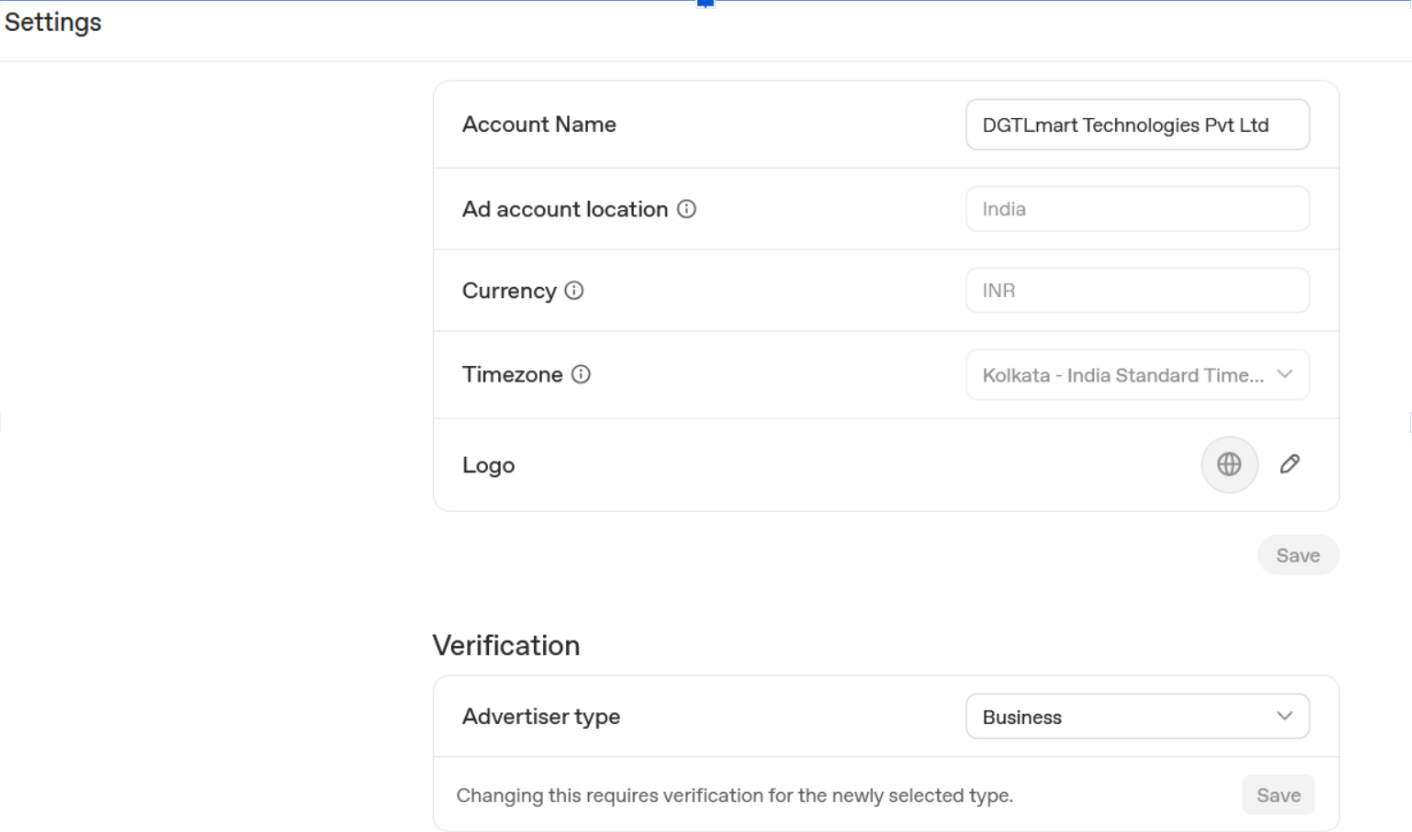
Start by accessing OpenAI Ads Manager and signing in with your OpenAI account.
During setup, provide the required business information.
This may include:
- Business name
- Website
- Industry
- Country
- Currency
- Time zone
- Business details
- Logo
Why country, currency and time zone matter
These settings affect how your advertising account is configured and how campaign reporting and billing are handled.
Therefore, don't rush through account creation.
Review these details carefully before submitting the account.
Complete Business Verification
Depending on the account and onboarding requirements, OpenAI may require business verification.
Verification helps establish that the advertiser is a legitimate business and provides the information required for advertising access.
You may need to provide information about your business and complete an identity/business verification process.
Recommended checklist
Before completing verification, make sure:
- Your business information is accurate.
- Your website is accessible.
- Your company name is consistent.
- Your logo is ready.
- Your business details are correct.
A mismatch between business information and submitted details can create unnecessary delays.
Set Up Billing
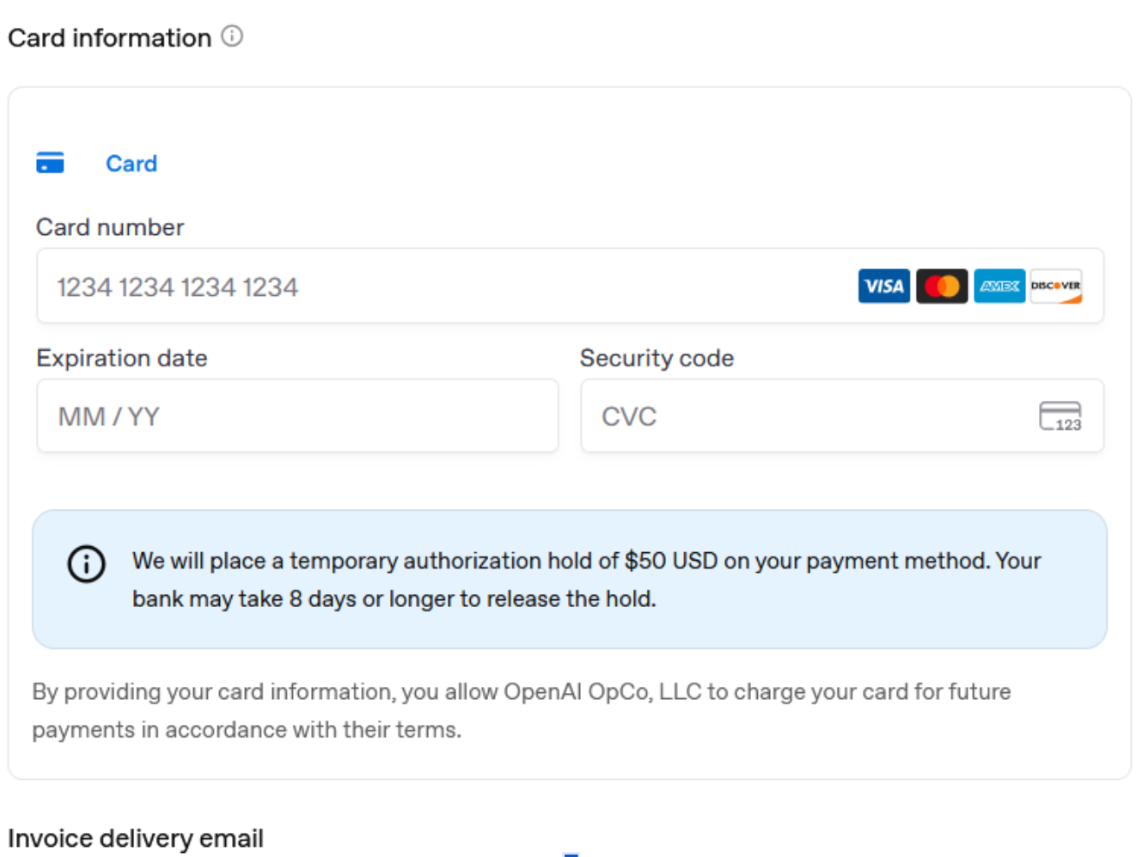
Once the advertising account is created, billing must be configured before campaigns can run.
Depending on the account setup, you may need:
- Billing information
- Payment method
- Business details
- Tax-related information
Think of billing as a prerequisite rather than something to configure after creating the campaign.
A campaign can be perfectly structured but still fail to deliver if the account isn't financially ready.
Understand the OpenAI Ads Campaign Structure
Before creating your first campaign, understand the hierarchy.
Campaign
The campaign defines the overall marketing goal.
For example: AI SEO Lead Generation
Ad Group
The ad group defines a specific theme or audience/context.
For example: GEO Services
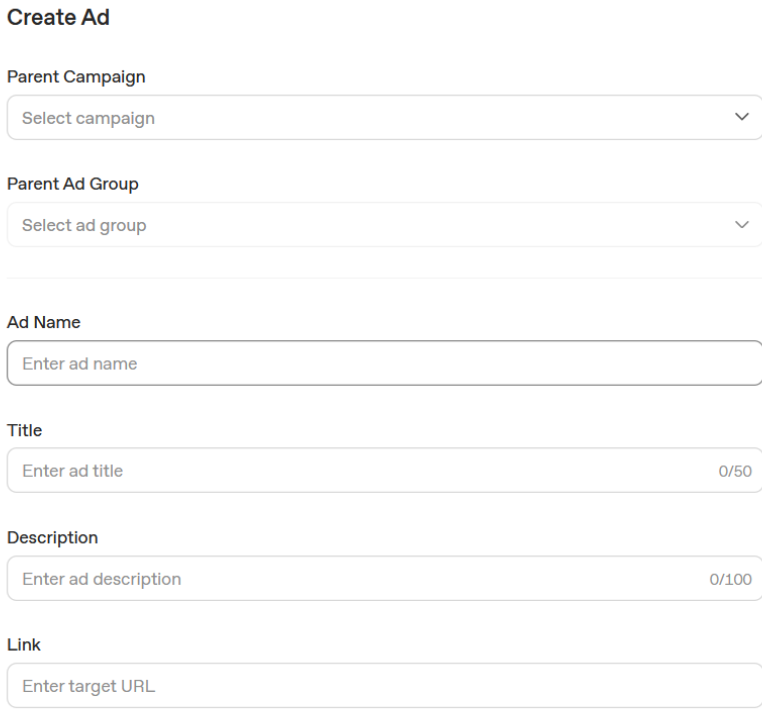
Ad
The ad is the actual creative.
For example:
Title: Get Found in AI Search
Copy: Improve your visibility across AI search.
The structure looks like this:
Campaign → Ad Group → Multiple Ads
This structure makes campaign management and performance analysis easier.
What Are the Different Types of OpenAI Ad Campaigns?
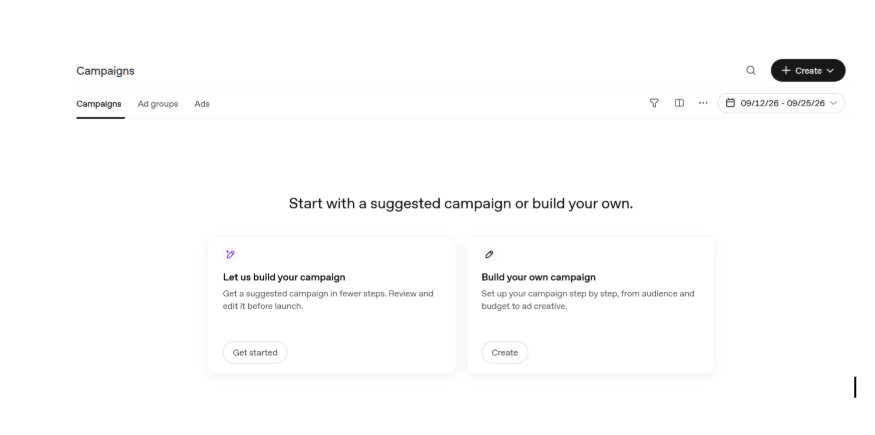
One of the most important decisions is choosing the campaign objective.
OpenAI currently provides campaign objectives including:
- Views
- Clicks
- Conversions
Each objective serves a different business purpose.
Views Campaigns
A Views campaign is designed around getting advertising exposure.
The objective is primarily visibility.
This type of campaign can be useful when the business wants to introduce:
- A new brand
- A new product
- A new service
- A new category
- A major campaign
Example:
Suppose DGTLmart launches a new service: AI Search Optimization
A Views campaign could be used to introduce the concept to a relevant audience.
The campaign isn't necessarily asking every person to submit a lead immediately.
Instead, the objective is to create awareness.
When should you consider Views?
Use this approach when your primary objective is: "I want more relevant people to know about my brand or offer."
Clicks Campaigns
Clicks campaigns focus on generating traffic to your destination.
This can be useful for:
- Landing pages
- Blog articles
- Product pages
- Service pages
- Free tools
- Demo pages
For example:
Ad: Get Found in AI Search ↓
Landing Page: AI SEO Services ↓
CTA: Get Free AI Visibility Audit
The goal is to move the user from ChatGPT to your website.
When should you use Clicks?
Clicks can be useful when you are still testing:
- Ad messaging
- Landing pages
- Audience/context
- Content offers
However, marketers should avoid treating clicks as the final business goal when the real objective is lead generation or sales.
Conversion Campaigns
Conversion campaigns focus on actions that matter to the business.
Examples include:
- Lead submission
- Registration
- Purchase
- Demo request
- Consultation request
- Other supported conversion actions
Consider an AI SEO agency.
Getting 1,000 visitors isn't necessarily valuable if nobody becomes a prospect.
Instead, the agency might define: Conversion = Qualified Lead
The funnel becomes:
Advertisement → Landing Page → Lead Form → Qualified Lead → Sales Call → Customer
This is much closer to actual business performance.
Product Feed Campaigns
For ecommerce advertisers, product-feed campaigns can be particularly relevant.
Instead of manually creating an advertisement for every product, a product feed can provide product information that can be used to organize advertising around product categories or filters.
For example:
Product Feed → Running Shoes → Men's Running Shoes → Product Ads
This can be useful for businesses with:
- Large ecommerce catalogs
- Multiple product categories
- Shopify stores
- Retail inventories
- Large numbers of SKUs
The strategy becomes more scalable because product information can be managed through the feed rather than creating every product advertisement individually.
How to Define Your Target Audience
Audience targeting is one of the most important parts of campaign planning.
But don't start with: "Who should see my advertisement?"
Start with: "Who has the problem my product solves?"
For example, a digital marketing agency may define its audience as:
Marketing managers at B2B companies who are concerned about declining organic search visibility and increasing AI-generated search results.
That is much more useful than simply saying: "People interested in SEO."
Think in Terms of User Problems
Imagine a company selling accounting software.
Instead of targeting only: Accounting software
think about conversations such as:
- "What is the best accounting software for a small business?"
- "How can I automate invoices?"
- "How can I reduce manual bookkeeping?"
- "Which accounting software integrates with my CRM?"
Each conversation represents a different intent.
The advertiser can then build different ad groups around these needs.
Understanding Context Hints
Context hints help communicate when an advertisement may be relevant.
They should describe the problem, use case or context associated with the offering.
Weak context
SEO (This is too broad.)
Stronger context
Businesses looking to improve visibility in AI-generated search results.
Another example:
Weak: CRM
Stronger: Companies looking for CRM software to automate lead management and sales follow-up.
The second version provides considerably more context about the user's potential need.
Create Intent-Based Ad Groups
Rather than putting every audience into one large ad group, divide campaigns according to meaningful intent.
For an AI SEO company, you could create:
Ad Group 1 — AI SEO
Context:
- AI SEO services
- AI search optimization
- Improving visibility in AI search
- Optimizing websites for AI-generated answers
Ad Group 2 — GEO
Context:
- Generative Engine Optimization
- AI search visibility
- AI citations
- Visibility in AI-generated answers
Ad Group 3 — AI Visibility Audit
Context:
- Check AI visibility
- AI brand visibility
- ChatGPT visibility
- AI search audit
This approach makes the relationship between intent, advertisement and landing page much clearer.
Geographic Targeting
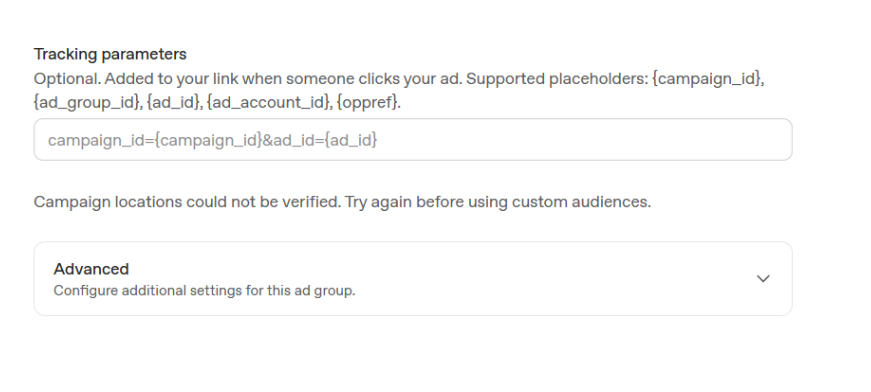
OpenAI Ads campaigns can use geographic targeting where available.
For example, an international agency could create separate campaigns for:
- United States
- Canada
- United Kingdom
- Australia
- India
Why separate campaigns?
Because different markets may have different CPC, conversion rates, customer values, competition, demand and sales cycles.
Instead of combining everything into one campaign, separating major markets can make performance analysis easier.
Platform Targeting
Depending on campaign eligibility, advertisers can target different ChatGPT platforms such as Web, iOS, and Android.
This creates another dimension for campaign analysis.
For example, you might discover that:
Web users → more lead submissions
while:
Mobile users → more engagement
The correct strategy should ultimately be determined from campaign data rather than assumptions.
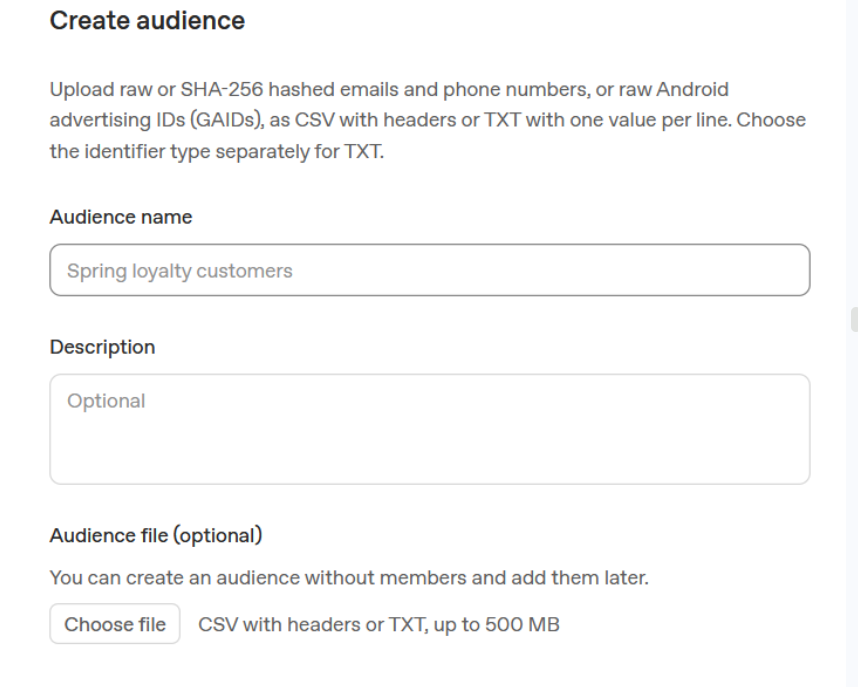
Custom Audiences
Advertisers can also use custom audiences where available.
These can be useful for:
- Existing customers: You may want to exclude customers from a prospecting campaign.
- Existing leads: You may want to advertise a different offer to people who already submitted a lead.
- High-value prospects: You may want to create a specific audience strategy for an identified customer group.
Audience availability and minimum audience requirements can vary by campaign functionality, so advertisers should check the current OpenAI Ads documentation before building the campaign around custom audiences.
How to Create Your First Campaign
Once your strategy is ready, create the campaign.
A practical campaign structure could be:
Campaign Name: USA_AI_SEO_Lead_Generation
Objective: Conversions
Country: United States
Platforms: Eligible platforms
Budget: Defined monthly/daily test budget
Then create the ad groups.
How to Create an Ad Group
For example:
Campaign: AI SEO Lead Generation ↓
Ad Group: AI Search Visibility ↓
Context: Businesses looking to improve their visibility in ChatGPT and AI-generated search results.
Then create multiple ads within that ad group.
How to Write OpenAI Ads
A good advertisement should quickly answer three questions:
- What are you offering? (Example: AI Search Optimization)
- Why does it matter? (Example: Improve your visibility in AI search.)
- What should the user do? (Example: Get an AI Visibility Audit)
Keep the message concise.
Don't try to explain your entire business inside the advertisement.
The ad should generate enough interest for the user to take the next step.
Example OpenAI Ad
Title: Get Found in AI Search
Copy: Improve your visibility across AI search.
CTA: Get Free Audit
Landing Page: AI SEO / GEO service page
This creates a simple relationship: Problem → Solution → Action
Create Multiple Creative Variations
One advertisement should not be treated as the final answer.
Create multiple variations.
- Variation A: Get Found in AI Search
- Variation B: Is AI Finding Your Brand?
- Variation C: Boost Your AI Visibility
Each can communicate a slightly different value proposition.
After collecting sufficient data, compare performance and determine which messages are generating stronger results.
Landing Page Is Just as Important as the Ad
A common advertising mistake is creating a good advertisement and sending users to a generic homepage.
Imagine someone sees: Get Found in AI Search and clicks.
They should land on a page that immediately explains: AI Search Visibility Services (not a generic homepage containing 20 unrelated services).
The landing page should continue the same message.
Advertisement → Landing Page → Offer → Conversion (Submit Your Website)
This is called message matching.
Build a Conversion Funnel
A good OpenAI Ads campaign shouldn't stop at the click.
Build the entire funnel:
ChatGPT Conversation ↓ Advertisement ↓ Landing Page ↓ Offer ↓ Lead Form ↓ Qualified Lead ↓ Sales Team ↓ Customer
Every stage should be measurable.
How to Measure Campaign Performance
There are two types of metrics you should monitor.
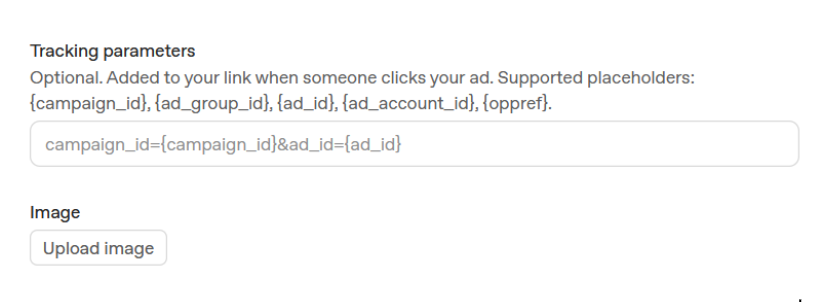
Advertising metrics
- Impressions
- Clicks
- CTR
- CPM
- CPC
- Spend
- Conversions
Business metrics
- Leads
- Qualified leads
- Sales calls
- Customers
- Revenue
- Customer acquisition cost
- ROAS
The second group is ultimately more important for a performance campaign.
A campaign generating cheap clicks but no customers requires a different strategy from one generating expensive clicks that consistently produce profitable customers.
How to Optimize an OpenAI Ads Campaign
Campaign optimization should follow the funnel.
- Problem 1: Low impressions — Check budget, eligibility, targeting, audience/context, campaign status, bid/settings.
- Problem 2: Good impressions but low clicks — Look at title, ad copy, creative, relevance, offer.
- Problem 3: Good clicks but low conversions — Look at landing page, page speed, CTA, lead form, offer, message matching.
- Problem 4: Good leads but poor sales — Look at lead quality, sales qualification, follow-up time, sales process, pricing, offer.
This prevents marketers from changing the wrong part of the campaign.
How to Scale a Successful Campaign
Once a campaign produces reliable conversion data, scaling should be controlled.
Don't immediately double the budget simply because you received several conversions.
Instead:
- Identify the strongest ad groups.
- Identify the strongest creative.
- Identify the strongest geographic markets.
- Identify the strongest audience/context.
- Review conversion quality.
- Increase budget gradually.
- Continue monitoring acquisition costs.
Scaling should be based on repeatable performance, not a small amount of early data.
Example OpenAI Ads Strategy for DGTLmart
For DGTLmart, the account could eventually be structured around several business objectives.
Campaign 1: AI SEO Lead Generation
Ad groups: AI SEO, GEO, AI Search Visibility, AI Visibility Audit
Campaign 2: ChatGPT Ads Agency
Ad groups: ChatGPT Advertising, OpenAI Advertising, AI Advertising, ChatGPT Ads Agency
Campaign 3: Digital Brand Authority
Ad groups: Founder Branding, Personal Brand, Digital Authority, AI Brand Visibility
Campaign 4: Free AI Visibility Audit
Ad groups: AI Visibility Check, ChatGPT Brand Check, AI Search Audit, AI SEO Audit
Each campaign should have its own landing page and conversion objective where practical.
Recommended Budget Testing Approach
There is no universal budget that guarantees results.
Instead, start with a defined testing budget.
For example, if a business allocates ₹1 lakh per month, it could initially divide the budget across several strategic campaigns:
| Campaign | Test Budget |
|---|---|
| AI SEO | ₹30,000 |
| ChatGPT Ads | ₹20,000 |
| AI Visibility Audit | ₹20,000 |
| Digital Brand Authority | ₹15,000 |
| SEO Services | ₹15,000 |
| Total | ₹1,00,000 |
This is an example testing allocation, not a guaranteed performance benchmark.
After sufficient data is collected, budget can be redistributed according to actual conversion performance and business value.
Common Mistakes to Avoid
Mistake 1: Treating ChatGPT Ads like Google Ads
Don't simply copy your Google keyword list. Think about conversations and user problems.
Mistake 2: Using very broad context
Something like Marketing is unlikely to provide enough useful context. Make the context specific.
Mistake 3: Sending all traffic to the homepage
Create landing pages that match the advertisement.
Mistake 4: Running only one creative
Use multiple messages and creative variations.
Mistake 5: Measuring only clicks
A click isn't necessarily a business result. Measure: Click → Lead → Qualified Lead → Customer
Mistake 6: Scaling too quickly
Give campaigns enough data before making major budget changes.
Mistake 7: Mixing different intents
Someone researching "What is GEO?" has a different intent from someone asking "Which GEO agency should I hire?" Separate informational and commercial intent where appropriate.
The Future of Advertising Is Becoming More Conversational
Traditional digital advertising was largely built around Keywords + Demographics + Websites
AI-driven discovery introduces another layer: Context + Conversation + Intent + Relevance
This creates an important opportunity for marketers.
Businesses need to understand not only "What does my customer search?" but also "What does my customer ask an AI when they have a problem my business can solve?"
That question can become the foundation for an effective ChatGPT advertising strategy.
OpenAI Ads should not be approached simply as another advertising platform where marketers copy their existing Google or Meta campaigns.
The strongest campaign planning starts with understanding the customer problem and conversational context, then connecting that context to the right campaign objective, ad group, advertisement and landing page.
The complete process can be summarized as:
Business Goal → Target Customer → Customer Problem → Conversation Context → Campaign Objective → Ad Group → Advertisement → Landing Page → Conversion → Optimization
The advertisers that understand this complete journey will be better positioned to test and learn as ChatGPT advertising develops.